
The Transformative Benefits of Artificial Intelligence
How AI is reshaping healthcare, business, education, and everyday life — and why the revolution is only just beginning.
By Expert Content Writer · April 18, 2026 · 10 min read
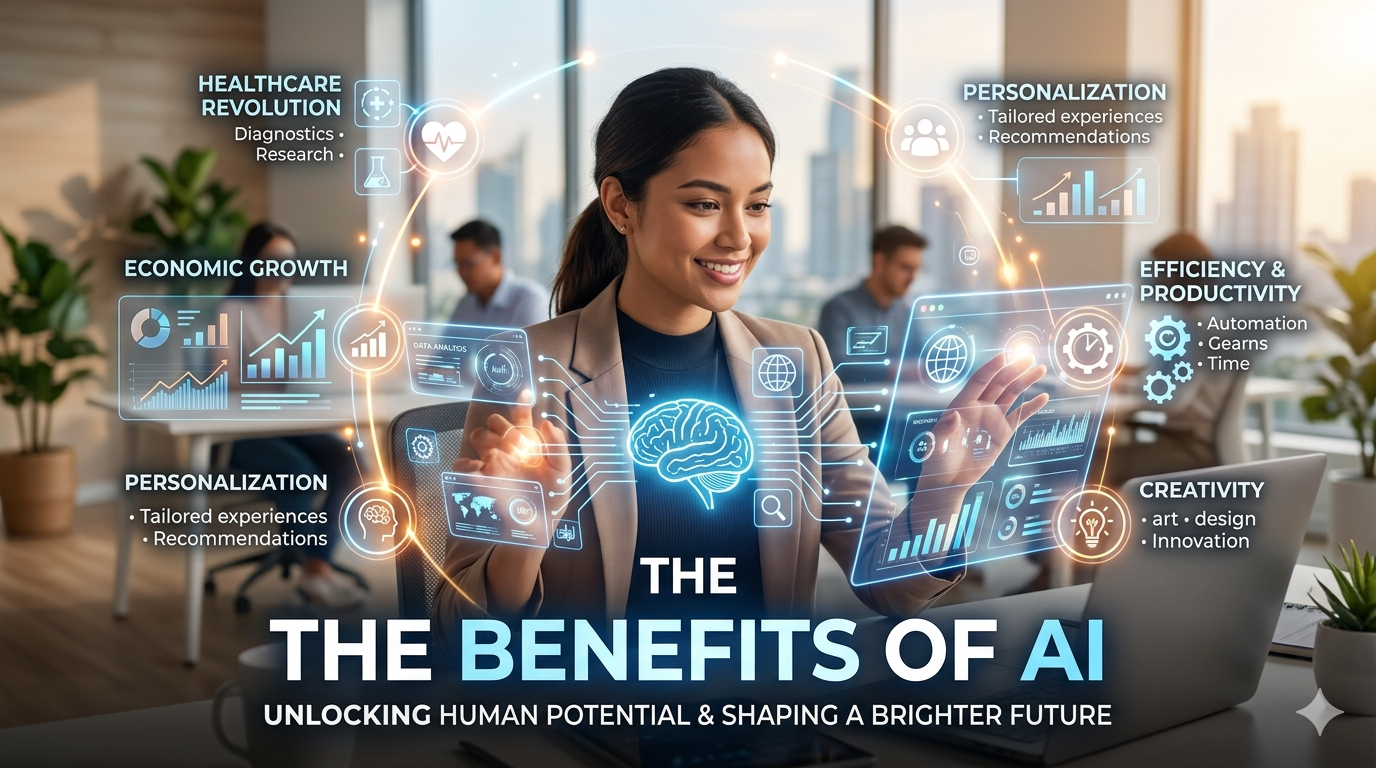
Artificial Intelligence is no longer a futuristic concept confined to science fiction. It is here, it is now, and it is reshaping the very foundations of how we live, work, learn, and heal. From the smartphone in your pocket to the algorithms predicting climate change, AI’s fingerprints are everywhere — and the benefits it delivers are nothing short of extraordinary.
What Is Artificial Intelligence and Why Does It Matter?
Artificial Intelligence refers to computer systems capable of performing tasks that typically require human intelligence — such as understanding language, recognizing images, making decisions, and solving complex problems. Since Alan Turing first posed the question “Can machines think?” in 1950, humanity has marched steadily toward a world where that question has become largely academic. Machines do think — and increasingly, they think better, faster, and more consistently than we do.
The global AI market was valued at over $200 billion in 2025 and is projected to surpass $1.8 trillion by 2030. Behind these staggering numbers lies a simple truth: AI works. It delivers measurable, tangible value across virtually every sector of human activity. Understanding its benefits is no longer optional — it is essential for anyone who wants to navigate the modern world with clarity and confidence.
$1.8TAI Market by 2030
40%Productivity Gains Reported
97MNew AI Jobs by 2025
70%Businesses Using AI Tools
Revolutionizing Healthcare and Medicine
Perhaps nowhere is AI’s impact felt more profoundly than in the realm of human health. The marriage of artificial intelligence and medicine is producing outcomes that were unimaginable just a decade ago — earlier diagnoses, faster drug discoveries, and personalized treatments that adapt to individual patients in real time.
Early Detection and Diagnostic Accuracy
AI-powered diagnostic tools now outperform experienced radiologists in detecting certain cancers — including breast cancer, lung cancer, and diabetic retinopathy — with accuracy rates exceeding 94%. Google’s DeepMind developed an AI that can detect over 50 eye diseases from retinal scans with expert-level precision. These systems do not replace doctors; they amplify them, catching what the human eye might miss during a long shift or a heavy caseload.
Drug Discovery at Machine Speed
Traditional drug discovery can take 10 to 15 years and cost upwards of $2.6 billion. AI is compressing this timeline dramatically. AlphaFold, developed by DeepMind, solved the protein-folding problem — one of biology’s greatest mysteries — and in doing so, opened a door to accelerated development of treatments for Alzheimer’s, Parkinson’s, and countless rare diseases. AI platforms can now screen billions of molecular compounds in the time it would take a human team months to test a handful.
Personalized Treatment Plans
AI analyzes a patient’s genetic profile, medical history, lifestyle data, and real-time biomarkers to recommend treatment plans tailored specifically to them. This shift from one-size-fits-all medicine to precision healthcare is improving outcomes, reducing side effects, and cutting unnecessary procedures.
Remote Patient Monitoring
Wearable devices powered by AI continuously monitor heart rate, blood oxygen, glucose levels, and sleep patterns — alerting physicians to anomalies before they become emergencies. AI-enabled telemedicine has expanded quality healthcare access to remote and underserved communities worldwide.
✦
Supercharging Business Productivity and Innovation
In the boardroom and on the factory floor, AI is redefining what it means to be efficient, competitive, and innovative. Businesses that have embraced AI report productivity gains of 30–40%, reduced operational costs, and dramatically improved customer experiences.
Artificial Intelligence will be the defining competitive advantage of the 21st century. The companies that learn to harness it wisely will lead their industries. Those that don’t will struggle to keep up.
Automation of Repetitive Tasks
AI-powered automation is liberating the human workforce from the drudgery of repetitive, low-value tasks — data entry, invoice processing, customer query routing, inventory management. Robotic Process Automation (RPA) combined with AI can handle thousands of transactions per second with near-zero error rates, freeing employees to focus on creative, strategic, and interpersonal work where humans still hold a decisive advantage.
Smarter Decision-Making Through Data
Modern businesses generate oceans of data. AI is the only tool capable of diving into those depths and surfacing actionable insights in real time. Predictive analytics platforms can forecast demand, detect fraud, identify supply chain disruptions, and model the likely outcomes of strategic decisions — all before a human analyst has finished their morning coffee. Companies using AI-driven decision-making report up to 25% higher profits than their less data-savvy competitors.
Enhanced Customer Experience
From Netflix’s recommendation engine to Amazon’s personalized shopping suggestions, AI is making every customer interaction feel uniquely tailored. AI chatbots now handle millions of customer service queries daily, resolving issues faster and at a fraction of the cost of human agents, while machine learning ensures every interaction makes the next one smarter.
Supply Chain Optimization
AI models predict disruptions, optimize inventory levels, and reroute logistics in response to real-world events — reducing waste, lowering costs, and ensuring products reach consumers faster and more reliably than ever before.
✦
Transforming Education for Every Learner
Education is one of the most powerful forces in human society, and AI is making it more accessible, effective, and personalized than at any point in history. The traditional model — one teacher, thirty students, a single curriculum — is giving way to something far more dynamic and responsive.
Personalized Learning Pathways
AI-powered educational platforms like Khan Academy’s Khanmigo and Duolingo’s adaptive engine assess each learner’s strengths, weaknesses, and preferred learning style in real time. They then adjust content, pacing, and challenge level accordingly. A student who struggles with fractions gets more practice and alternative explanations; one who excels is accelerated to more complex material. This is individualized instruction at a scale no human teacher can match alone.
Breaking Down Language Barriers
AI translation and language-learning tools are dismantling one of education’s oldest barriers. Real-time translation makes educational content accessible in hundreds of languages. AI writing assistants help non-native speakers express their ideas clearly and confidently, while language models are enabling new forms of interactive language learning that mimic immersive experience more than any textbook ever could.
Intelligent Tutoring and Feedback
AI tutors provide instant, detailed feedback on essays, math problems, and coding assignments — the kind of timely, personalized guidance that most students have never had access to outside of expensive private tutoring. Studies show that students using AI tutoring systems learn at twice the rate of those in traditional classroom settings.
Identifying At-Risk Students Early
By analyzing attendance patterns, assessment scores, and engagement data, AI systems can flag students at risk of falling behind — giving counselors and teachers the opportunity to intervene before a small struggle becomes a major crisis.
✦
Protecting Our Planet with Intelligent Technology
The climate crisis demands solutions at a scale and speed that human effort alone cannot deliver. AI is emerging as one of the most powerful tools in the environmental arsenal — helping scientists model climate systems, optimize energy grids, monitor deforestation, and accelerate the transition to renewable energy.
Optimizing Energy Consumption
Google’s DeepMind AI reduced the energy used to cool its data centers by 40% — a staggering achievement with global implications. Smart grid systems powered by AI balance electricity supply and demand in real time, reducing waste and integrating renewable sources more effectively. AI is helping cities become smarter and more energy-efficient, from intelligent street lighting that dims when roads are empty to HVAC systems that learn building occupancy patterns and adjust accordingly.
Climate Modeling and Prediction
AI is processing petabytes of satellite imagery, ocean sensor data, and atmospheric measurements to build climate models of unprecedented accuracy. These models help scientists predict extreme weather events, understand ecosystem changes, and inform the policy decisions that will shape humanity’s response to the climate emergency for decades to come.
Wildlife Conservation
AI-powered camera systems and acoustic sensors monitor endangered species populations in real time, detecting poaching activity, tracking migration patterns, and helping conservationists allocate limited resources where they will have the greatest impact. Projects like Wildlife Insights use AI to identify species in millions of camera trap photos that would otherwise take years for human researchers to review.
Precision Agriculture
AI helps farmers use water, fertilizer, and pesticides with surgical precision — reducing environmental runoff, cutting costs, and increasing crop yields. Drone systems guided by AI can monitor thousands of acres of cropland, identifying disease, drought stress, and pest infestations before they spread.
✦
Enhancing Everyday Life in Ways We Barely Notice
Not all of AI’s benefits arrive with fanfare. Many of the most profound improvements to daily life are nearly invisible — woven so seamlessly into our routines that we only notice them when they’re absent.
Safety, Security, and Smart Living
AI-powered navigation apps like Google Maps and Waze analyze real-time traffic data from millions of drivers to suggest the fastest routes, saving commuters billions of hours annually. Autonomous vehicle technology is advancing steadily, promising a future where the 1.35 million annual road deaths caused by human error become increasingly preventable. Smart home devices learn your preferences and routines, adjusting temperature, lighting, and security systems to suit your life.
Cybersecurity and Fraud Prevention
Banks and financial institutions use AI to analyze transaction patterns and flag suspicious activity in milliseconds — stopping fraud before it causes harm. Cybersecurity platforms powered by machine learning identify and neutralize threats far faster than any human analyst, protecting individuals and organizations from an ever-evolving landscape of digital threats.
Creative Expression and Accessibility
AI tools are democratizing creativity — helping musicians compose, writers draft, designers prototype, and filmmakers edit with unprecedented speed and flexibility. For people with disabilities, AI-powered tools like real-time captioning, text-to-speech, and computer vision assistance are expanding independence and participation in ways that transform lives.
Mental Health Support
AI-powered mental health apps offer evidence-based cognitive behavioral therapy techniques, mood tracking, and 24/7 support to millions who lack access to traditional mental healthcare. While no app replaces a therapist, these tools are filling a critical gap in the global mental health crisis.
✦
The Road Ahead: Embracing AI’s Promise Responsibly
The benefits of artificial intelligence are vast, varied, and still unfolding. We are, in a very real sense, living through the early chapters of a transformation as significant as the Industrial Revolution — one that will reshape every aspect of human civilization over the coming decades.
To be clear, the technology is not without challenges. Questions of bias, privacy, job displacement, and ethical governance demand serious, ongoing attention. But the answer to these challenges is not to retreat from AI — it is to develop it thoughtfully, deploy it equitably, and regulate it wisely.
Because on the other side of those challenges lies a world where cancer is caught earlier and treated more effectively, where every child receives an education tailored to their unique potential, where businesses run more efficiently and sustainably, where our planet is monitored and protected with unprecedented precision, and where the mundane burdens of daily life are quietly, reliably handled by machines — freeing humanity to focus on what we have always done best: imagine, connect, create, and care for one another.
The age of artificial intelligence is not something happening to us. It is something we are building together. And the benefits, for those willing to engage with it wisely, are beyond measure.
AI is not a replacement for human intelligence — it is its greatest amplifier. The future belongs to those who learn to use both in harmony.
© 2026 AI Insights Journal · Expert Analysis · All Rights Reserved